Mathematics

Think, Solve, Discover!
Building problem-solving skills and a love of numbers through hands-on learning.

Through learning mathematics, students build strong number skills and learn to think clearly, creatively and logically. They explore patterns, relationships and real-life problems, helping them see how maths connects to the world around them. As they grow, students become more confident and fluent in using mathematical ideas to communicate, reason and solve challenges. By engaging in meaningful and appropriately challenging tasks, students develop a positive attitude towards maths and the confidence to apply their learning in everyday life and future studies.

The whole school will be using the department unit of work which have a mathematical thinking focus and encourage students to talk about their ideas. Multiple concepts are taught together in each unit and they are adapted to meet the needs of our class. The lessons include lots of games and hands on activities.

Maths throughout the Stages

Kindergarten

MultiLit has created a Maths program, similar to InitiaLit. It is called InitialMaths and is currently in its trial phase. MPS was very lucky to be chosen as one of four schools in Australia to trial the program. MultiLit programs are very well respected and we are so lucky to have this opportunity.  As part of the trial, we teach the lessons and provide feedback. We conduct our own assessments (as we normally would) but they also send a team to conduct their own testing.

Stage 1

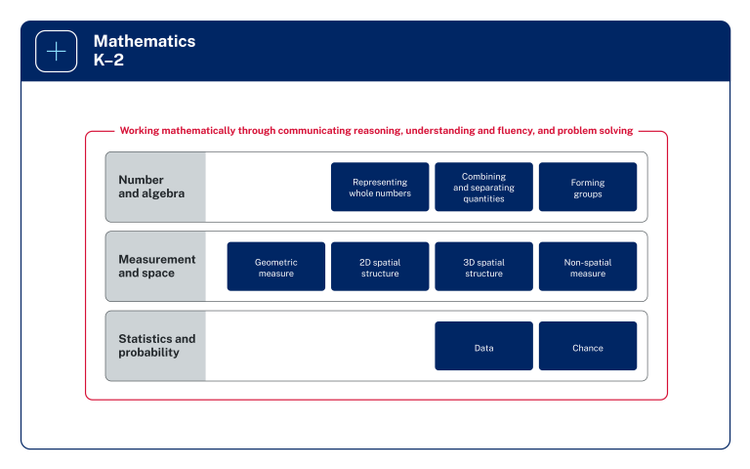
In Stage 1 Mathematics, students build on their early number sense and begin to use a range of strategies to add, subtract, group and share. They explore patterns and relationships in numbers and shapes, and begin working with halves and quarters. Students learn to measure and compare length, mass, capacity, and time using informal and formal units. They recognise, describe and create two-dimensional and three-dimensional shapes and use simple maps and directions to describe position and movement. Students also collect and display data and talk about the likelihood of events using everyday language.

Figure 1 gives a diagrammatic overview of the focus areas and the relationship of working mathematically to all areas of the syllabus.

Stage 2

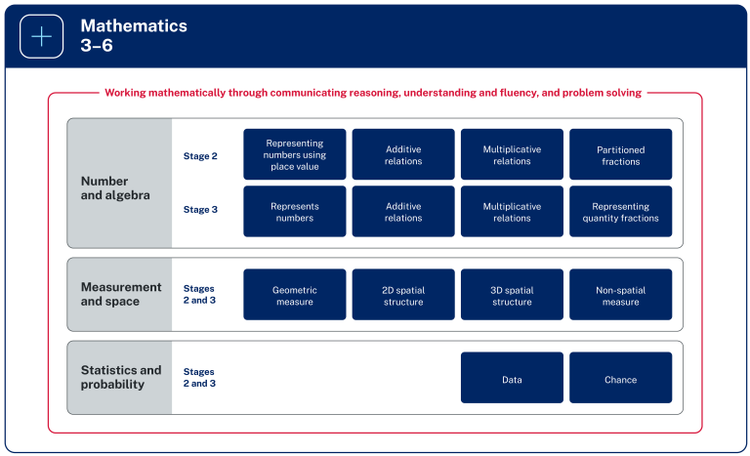
In Stage 2 Mathematics, students build on their early number skills to develop stronger understanding and confidence across key areas. They learn to use efficient strategies for addition, subtraction, multiplication and division, and explore fractions and decimals. Students measure length, area, mass, capacity and time, and describe three-dimensional objects and two-dimensional shapes. They collect, represent and interpret data, and begin to recognise and predict chance events. Throughout, they apply mathematical reasoning and problem-solving skills to real-life situations, helping them make sense of the world using numbers and patterns.

Stage 3

In Stage 3 Mathematics, students extend their understanding of number and operations by working confidently with larger numbers, fractions, decimals and percentages. They apply efficient strategies to solve problems involving the four operations and use mental and written methods effectively. Students explore area, volume, angles and transformations, and use formulas to calculate perimeter and area. They interpret and analyse data using graphs and tables, and develop a stronger understanding of chance. Throughout Stage 3, students apply reasoning, communicate their mathematical thinking and use problem-solving strategies in real-world and abstract contexts, preparing them for the transition to high school mathematics.

Figure 2 gives a diagrammatic overview of the focus areas and the relationship of working mathematically to all areas of the syllabus.

Learning

Find out about our approach to learning and supporting students to progress.

Travel to school

Learn about local transport options and how to get here safely.